
What does the text allow for? That seems to be the most important question for those interpreting Shakespeare for modern audiences these days, especially when transporting that text to different settings. The E&P have given us a female Othello and a swinging Sixties Two Gentlemen of Verona after all – so perhaps we shouldn’t be surprised by this touring production of The Merchant of Venice, transplanted to the east end in 1936 and giving us a female Shylock, that was reviewed positively with words such as ‘timely’ and ‘relevant today’ last year.
Depressingly, there’s probably not been a time since it was first performed that this play on vengeance and racism hasn’t been resonant, but the casting of Tracy-Ann Oberman (who adapted Shakespeare’s most controversial play with Brigid Larmour) as ‘the first female Shylock’ lends another angle to this production. A vocal critic of Jeremy Corbyn’s handling of antisemitism, Oberman was obliged to pay damages to an academic she falsely accused of anti-semitic behaviour and it’s hard not to mull this background of modern-day battles over what anti-semitism looks like in the 21st Century when watching this intriguing production.

What’s clear from the off is that cast and crew have created a tight, fluent update on the play. The lines trip off the tongue, the direction is confident and dramatic moments hit hard. Whatever humour resides in the text is mined to good effect. Joseph Millson’s Arragon is a particular delight as he attempts to win the hand of Georgie Fellows’ Portia.
The Merchant of Venice 1936 deftly handles the required tonal shifts, from a comedy of manners to high-stakes drama. With the lush 1930s trappings and background whiff of Nazism its has inflections of Waugh or even Wodehouse.
The re-gendering of theatre’s most famous Jew allows for new readings of Shylock’s motivations. Her relationship with Jessica, Shylock’s daughter, who abandons her and renounces her own Judaism, should be more complex, although this doesn’t feel developed. However in the casually brutal treatment of Shylock there’s now a further inflection: not just race and religion, but gender too.
There are other curiosities. Elsewhere the relationship between Bassanio, perhaps the most obviously identifiable protagonist in most readings, and his patron Antonio is made a clearly romantic one. Whether this eas ever Shakespeare’s intention is another point that’s forever debated about The Merchant Of Venice.
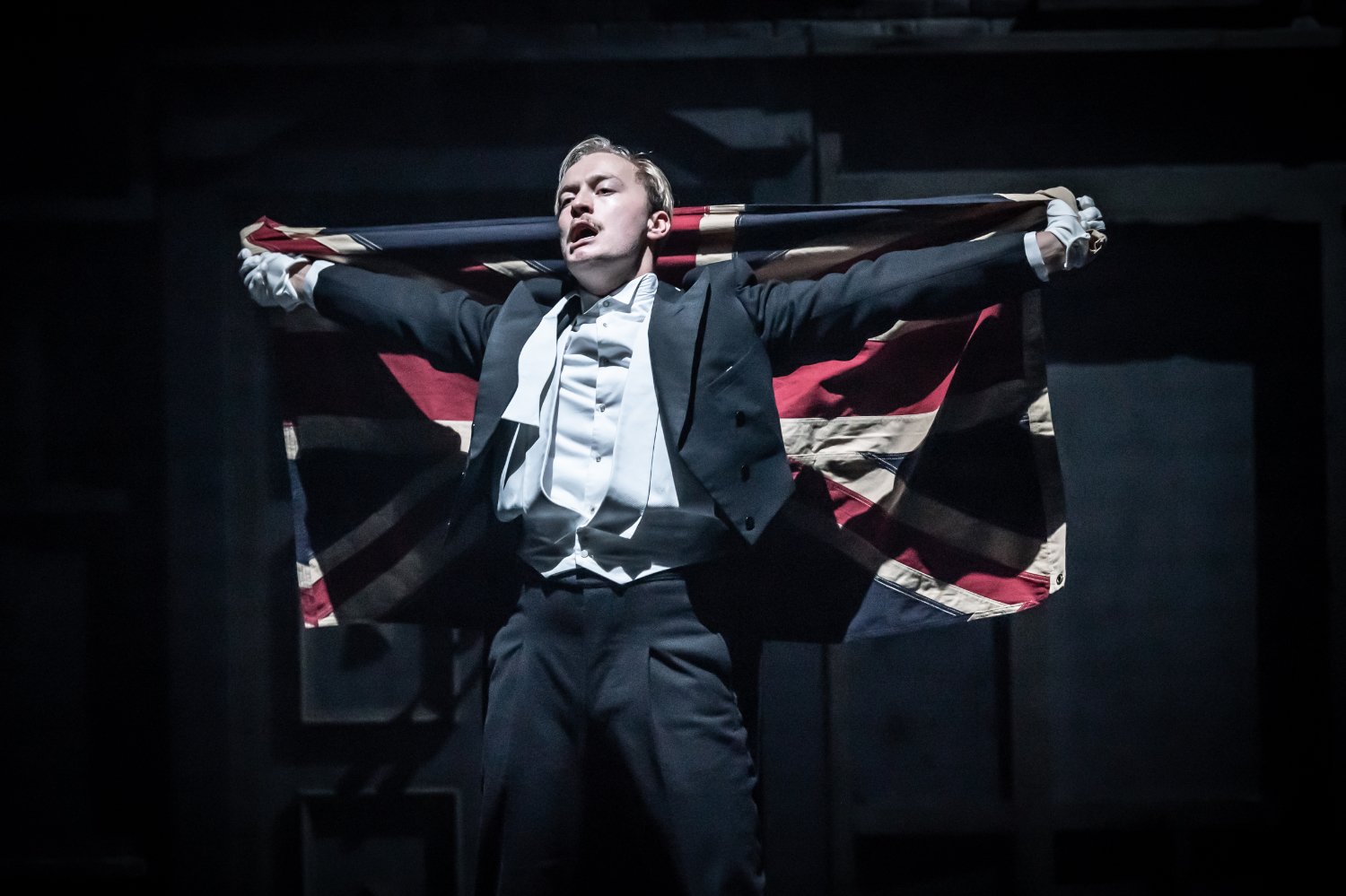
Perhaps the most significant change is in making most of the play’s Christian characters into Mosleysite blackshirts. Explicitly racist, particularly despising of Jews and giving off a horrible sense entitlement, it’s a startling filter through which to see this cast.
Their disgust at the appearance of Shylock’s daughter Jessica, even after her marriage to Lorenzo and subsequent conversion to Christianity, is explicit and turns The Merchant of Venice on its head. Despite the backdrop of contemporaneous headlines and footage detailing the rise of British fascism, nothing is as shocking as seeing the play’s notional protagonists displaying overt bigotry.

Set against this, Shylock’s demands for her pound of flesh are more understandable, there’s a strong sense of punching up; her humbling at the hands of Antonio and Portia – the former demanding her conversion to Christianity – made the audience audibly cringe.
There’s a rousing addition to the climax to the play, which feels awkward. However those watching could walk away with the words on their lips, ‘we are content’, and mean it.
The Merchant of Venice
Liverpool Playhouse
Until 8 February